Our vision is a Mississauga where everyone is food secure.



Advocate with Us
To create a food-secure Mississauga, we provide food to those who need it now and advocate to decrease the barriers that prevent food bank visitors from living poverty-free. Use your voice, and together, we can fight for policies to decrease poverty and provide sustainable futures for our neighbours!


Use your voice and join us in calling on the Ontario government to improve Ontario Works!
Why is Ontario Works a priority?
Check out our FAQ for more information on what Ontario Works is, how it affects food banks and those who depend on them and more.
-
Why do food banks care about social assistance programs like Ontario Works?
Poverty is the root cause of food insecurity, and government social assistance programs like Ontario Works have not kept up with inflation or the rising cost of living. As a result, people who find themselves close to or below the poverty line face an uphill battle out of poverty and increasingly rely on food banks. They are being legislated into poverty.
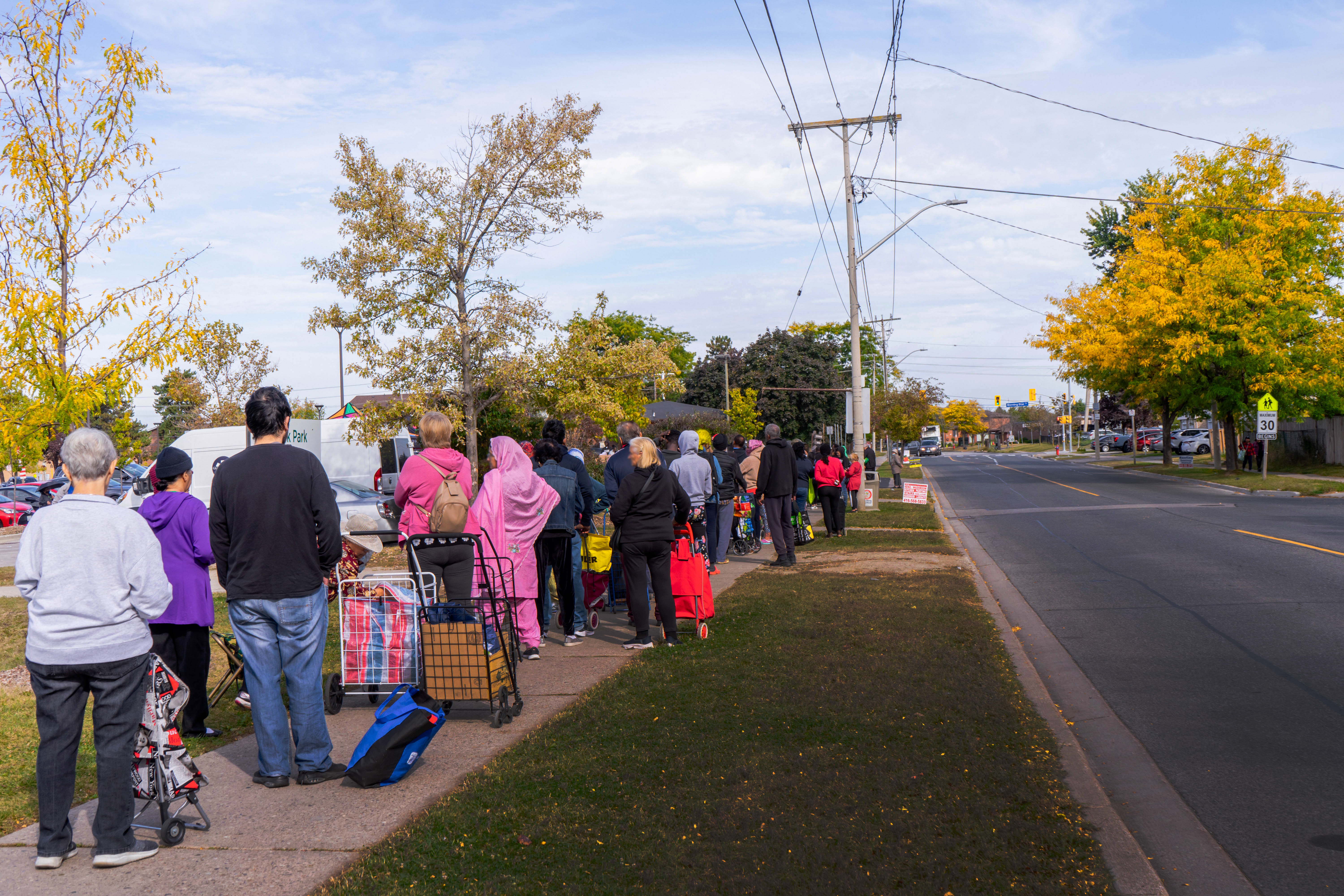
When food banks were formed across Canada in the 1980s during a recession, they were meant to be a temporary band-aid solution. A helping hand until folks were back on their feet. But 40 years later, food banks are still here, larger, and serving more people than ever before. 1 in 4 households across Canada report being food insecure.
Food banks were meant to act as the “emergency room” for neighbours in need, but they have become the “family doctor” because there are not enough adequate supports for people who are struggling.
-
What is Ontario Works?
Ontario Works (OW) is our province’s “welfare” program. It is meant to provide financial assistance for residents in financial need to help cover living expenses such as food and rent while they are between jobs. There are eligibility requirements in addition to financial need, such as being at least 16 years of age, an Ontario resident and proving that you are participating in what the government of Ontario calls “employment activities” (i.e. actively looking for employment, activities to improve skills).
There is a detailed application process, and applicants who are approved are assigned a caseworker to support them through the process and develop a plan that supports the required employment activities.
You may have come across some misconceptions about who is using OW. It’s important to understand that OW is meant to help people get back on solid ground. It is a temporary support until people can re-enter the workforce.
-
How much do people receive on Ontario Works?
The most that a single individual can receive on Ontario Works is $733 a month. $733 is nowhere near enough for food and housing.
OW has been frozen at $733 since 2018. As the cost of living rises, people who rely on this temporary income support can’t afford their basic needs. Another factor is that, unless they have had direct experience with OW, many Ontarians don’t know how limited this program is, and shedding light is important to grow public support.
Would you be able to live on $733 a month? Use Feed Ontario’s Fork in the Road interactive tool and select the ‘Angela’ persona to see how you would stretch $733 to make it through the month.
-
What happens when you find a job while on Ontario Works?
Ontario Works is meant to be a temporary income support to bridge a gap when people are between employment. People can begin working while on OW, but their support begins to be clawed back (50%/dollar) when they earn $200. That means that if you are an OW recipient and you start earning a minimum of $200 a month, the government will take away 50% of every dollar that you are meant to receive while on the OW program.
If the government were to raise the earnings exemption to $600, it would help people keep more of their own money before the clawback starts, making it easier for people to transition back to the workforce and get off OW sooner. An improved Ontario Works helps build a more secure workforce.
Let’s help Ontarians keep more of what they earn when returning to work.
-
What should the Ontario government to do about Ontario Works?
We are calling on the Ontario government to update Ontario Works so the program works the way it’s intended and strengthens Ontario’s workforce.
- Increase the rates that have been frozen since 2018 so they meet the current cost of living.
- Change the earnings exemption to $600 to allow people to keep more of their own money to help them get back to work sooner and off OW
While Ontario’s economy has changed drastically in the last eight years, OW has stayed the same. Updating the program to better meet the needs of Ontarians in 2026 would help OW work as designed, enabling Ontarians to transition back to the workforce more securely.
Make Ontario Works work better for Ontario.
-
How can I help?
Contact your Member of Provincial Parliament (MPP) about Ontario Works:
- If you don’t know who your MPP is, you can find your MPP here.
- Ask your MPP how they’re working to improve Ontario Works to help more of our neighbours get back to a more financially secure place.
- Everything costs more than it did in 2018, but OW rates haven’t changed to keep up with those rising costs. Ask your MPP when they are planning on updating OW and if we will see it in the upcoming Fall Economic Statement.
Our advocacy work aligns with Feed Ontario’s four advocacy priorities – a great place to continue your own advocacy work!
Improve Ontario's Social Assistance Programs

The income assistance provided by the Ontario Disability Support Program (ODSP) and Ontario Works (OW) is nowhere near enough for individuals to cover essentials such as food and rent. The most that a single person on ODSP can receive is $1,408 per month – that’s less than $17,000 per year. The most that a single person on OW can receive is $733 per month, which is under $9,000 per year. We must call on elected officials to align social assistance rates and benefits with cost of living and inflation, modernize the rules for these programs to ensure resiliency and dignity, and extend benefit coverage, and reduce barriers to accessing OW and ODSP.
Invest in Affordable Housing

Housing is often an individual’s single largest expense, and unaffordable housing continues to be a top reason why folks are visiting food banks more frequently and for longer.
77% of food bank visitors pay market rent, and Mississauga ranks 10th in Canada for the highest average rent for a one-bedroom unit at $2,165 per month. To invest in affordable housing, the government must build more social housing, implement real rent control, and expand the number of households that can receive the Canada-Ontario Housing Benefit.
Build a Stronger Workforce

While a low unemployment rate is one way to assess what percentage of Ontario’s total labour force is unemployed, it doesn’t tell the story of the quality of jobs, with more individuals relying on low-wage, precarious ‘gig’ work to get by. 18% of food bank visitors shared that employment is their primary source of income and with minimum wage ($17.60) falling far below a living wage ($26 in the GTA), those with employment will continue to be dependent on a food bank. To contribute to a stronger workforce, the government must develop and protect labour laws that benefit workers, allow low-income workers to keep more of their income by increasing earning exemptions and reducing clawbacks, and enhance programs like WSIB and EI.
Put People at the Centre

Our neighbours who have experience living in poverty are the experts on the realities of the challenges they face. To truly meet their needs, their perspectives must be included when elected officials make investments and policy changes. Consulting with people who have lived experiences of poverty, defining poverty and the outcomes we are working towards, and supporting the work of community organizations are key next steps.

More from our blog
Get the latest on our advocacy work

Mississauga Mayoral Debate hosted by Food Banks Mississauga & The Metamorphosis Network

2026 Municipal Election Policy Recommendations

40 Years of Service: Food Banks Mississauga Launches Thanksgiving Drive as They Report Prolonged Food Insecurity Emergency

Food is Culture

Hunger and Food Insecurity Know No Age Limit

Food as a Human Right
Let’s Talk Food Bank Misconceptions

Food Banks Mississauga Experienced Highest Annual Visits in its History

City of Mississauga Declares Food Insecurity an Emergency
Food Banks Canada Urges Canadians to Join the Call for Change

An interview with Kirstin Beardsley, CEO of Food Banks Canada
We are a welcoming and inclusive environment for all, regardless of any aspect of identity.
Contact us
If you’re looking for more information on how to use your voice to advocate on behalf of neighbours in need, reach out to us here!