

We are in the thick of Mississauga’s municipal election, and we participated by hosting a Mayoral debate last night in our Distribution Centre! You can check it out on YouTube, and you can read more about Food Banks Mississauga’s policy recommendations here.
One of the topics that has come up a lot is seniors and their ability to afford their homes and other expenses amid a rising cost of living. We do serve a number of seniors, especially through our Food Bank 2 Home delivery program. Some of them reach out to us initially trying to find affordable incontinence products, and then start to receive food deliveries after that.
Every time I think about that, I am so angry and sad. Think of the elders in your life – parents, grandparents, aunties and uncles. Now imagine them being in such a precarious financial situation that they have to call a charity for products to deal with their urine. It’s not right. No one should face that loss of dignity because of income.
While the issue of senior poverty must be addressed, how much of the food bank’s work is supporting seniors? How are seniors faring in Mississauga?
Here are the facts:
- 17% (119,400) of Mississauga’s population are seniors 65+.
- 8% (3,372) of Food Banks Mississauga visitors are seniors.
- 3% of Mississauga seniors are using the food bank.
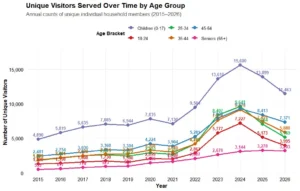
- Until 2022, seniors were the fastest-growing visitor demographic (Chart 1), increasing by approx. 23% per year. (Chart 2)
- Since 2022, growth in visitors has been driven by those aged 18-24 (Chart 1), increasing by 28% overall from 2019 to 2025 (Chart 2).
- Currently, 75% of our visitors are 45 and younger.
- Most are children (0-17), who make up 31% of food bank visitors. (Chart 3)
Chart 1:

Chart 2:
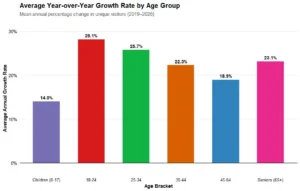
Chart 3:
As you can see, the largest group of food bank users are children under 17 and adults under 45. This is the reason why we are recommending the next Mayor Improve access to support services for low-income households. As those experiencing poverty struggle to match their meagre incomes to meeting their basic needs, the City and Region can provide support by ensuring access to vital services at low or no cost. By increasing no- or low-cost access to services such as childcare, transit, and recreation for low-income households, you will enable households to free up resources that can be redirected to buy food.
While these services are currently, in some cases, provided at no cost to seniors, we recommend transitioning to a means-tested delivery of taxpayer-funded services to ensure the most vulnerable households in Mississauga and Peel have access.
Recommendations:
- Make public transit more affordable for low-income residents by enhancing the Affordable Transit Program to provide free travel for eligible participants and investing to expand awareness of this program.
- Provide access to no- or low-cost recreation programs and community fitness for low-income residents.
- Ensure low-income residents are prioritized in access to other services.
Meghan Nicholls, CEO of Food Banks Mississauga
With over 20 years of experience in the nonprofit sector, Meghan worked with organizations dedicated to women’s development, international relief, and youth mental health before joining Food Banks Mississauga in 2009. Driven to end food insecurity in her own community, she has led Food Banks Mississauga to expand service by 340% while CEO. Meghan has served on Feed Ontario’s Board since 2020 and was elected Chair from 2022 – 2025. She holds a BA from York University, an Executive Certificate in Non-Profit Management from Georgetown University, and the Certified Fundraising Executive (CFRE) designation. In addition to a passion for her work, she enjoys doing crossword puzzles in a hammock, hanging out with her hubby, cats, and friends, and good cups of English breakfast tea.
Read more articles by Meghan at canadianfoodbanker.substack.com